Literacy teachers of young children often find themselves struggling to match their personal philosophpy with the mandates of their state, district, or school. Tests like ISTEP and IREAD have strict skill based requirements that children must be able to meet by the middle of the third grade. Up until this point, teachers are required to give assessments based on skills and conventions that will lead the students to do well on these tests.
Passionate, intentional teachers have the desire to fulfill their students' literacy lives by implementing developmentally appropriate activities into the curriculum. They want actiives that will inspire children to use the resources that they have around them to attmept the usage of challenging words and invent spelling and conventions as they progress on their journey to correct conventional writing.
The harsh pressure to reach certain skills by certain times may actually be hindering the stduents abilities to reach those goals becasue teachers feel pressure to reach these goals by taking a path that they do not believe in. The question is, where to go when there are two (often times more) different angles coming towards you about how to promote literacy. Teachers and administration need to work together to form a combination of discources that fit their school environment and individual students.
Tuesday, March 6, 2012

Tuesday, February 28, 2012
Does It Make Sense?
As many of us know and something I have previously mentioned in this blog is that it is oh so common to instruct children to "sound it out." What this phrase actually means can be dissected into various strategies like chunking and using the first letter of a word to figure out what the word is. When a word like "this" or "know" come into a reading, without previous memorization a child will not be able to simply "sound it out." This is when a child can turn to the strategy of filling in the blanks with a word that makes sense.

Using context clues can often be the most powerful method for students to use when learning more complicated words. This strategy also encourages reading comprehension, which is the true reason for achieving fluency and accuracy, right?
Encourage children to become investigators and detectives as they discover unknown words! Through practice, this strategy will become natural and students will be able to much more accurately identify unknown words and reach higher levels of comprehension.
Monday, February 20, 2012
Read What You Want!
We hear it over and over again as educators to run with student ideas, tweak your lessons to fit a stduent conversation, do activities that children are interested in and care about. What a wonderful world of education it would be if all of these things were happening all of the time! Although we know that these methods are the best ways to reach children and help them grow as students, we often fail, and one area that it is made easy for us to fail is in literacy. We have been given an "out" to adapting our instruction, and as a result, struggling readers are still struggling, and the education gap is widening.
This "out" that I am referring to is called leveling. Leveling is when texts are matched to readers based on the level that the student has tested into through generic assessments. Some of the leveling programs take many factors into account in these assessments, but many are based strictly on oral reading accuracy. How many of you think that reading level is based only on a child's ability to accurately and fluently read out loud?
This "out" that I am referring to is called leveling. Leveling is when texts are matched to readers based on the level that the student has tested into through generic assessments. Some of the leveling programs take many factors into account in these assessments, but many are based strictly on oral reading accuracy. How many of you think that reading level is based only on a child's ability to accurately and fluently read out loud?
That's what I thought.
So why is it that we turn to a system that uses instruction that we know is not the best way to help our children reach proficiency? There are many answers that can be found to that question when the system is disected, but the most simple answer is that in such an overwhelming, complex situation such as leveling, a techer is likely to get overwhelmed, abandon her personal strategies, and simply go by the book. Teachers are stripped of their independence and flexibility to engage when placed underneath a strict system. Either a teacher feels too overwhelmed or he is simply being too lazy to overcome the rigidity of the system.
Either way, there is an overreliance on materials and an underreliance on teacher abilities to take the task, the learner, the materials, and the context into account when giving reading instruction. Once a teacher is able to look past the system and see every outside force as a factor in a student's success, she will be able to choose appropriate, engaging texts for individuals and lead them to the proficiency we have been searching for.
Tuesday, February 7, 2012
Rethinking, Rephrasing, and Reconsidering
As teachers and parents, we all have memories of moments when a child is reading with you, and when they have a question about a word, the only answer that you have is, "sound it out." Sound it out... what are you telling a child to do when you are telling them to do this?
This is a question that a cultural model has left us to not ask. We have grown up being told this and this is the same instruction that we are continuing to give to out students, even though it is not the most effective. Studies have shown that the strategy of sounding it out by using individual letters or chunks of recognizable sounds are not truly the strategies that children naturally use. As teachers fostering the minds of these young children, we want to keep them from making as many mistakes as possible in their journey to reading. Common struggles that readers fall into when instructed to "sound it out" are the following:
-Recognizing the first letter of a word and replacing it with a different word that starts with that same letter
-Taking the context of a story and replacing a word with a word that has similar meaning
-Using the incorrect structure of a word
-Replacing a word with one that looks similar but may have a few different letters
-Asking for help to solve an unknown word
-Using individual letter sounds to come up with a word's whole sound
-Using chunks of words to come up with a word's whole sound
These are struggles that we need to identify in chidren and can word to steer away from by coming up with new, more beneficial strategies to help them. We need to be innnovative and rethink, rephrase, and reconsider the methods we are using.
This is a question that a cultural model has left us to not ask. We have grown up being told this and this is the same instruction that we are continuing to give to out students, even though it is not the most effective. Studies have shown that the strategy of sounding it out by using individual letters or chunks of recognizable sounds are not truly the strategies that children naturally use. As teachers fostering the minds of these young children, we want to keep them from making as many mistakes as possible in their journey to reading. Common struggles that readers fall into when instructed to "sound it out" are the following:
-Recognizing the first letter of a word and replacing it with a different word that starts with that same letter
-Taking the context of a story and replacing a word with a word that has similar meaning
-Using the incorrect structure of a word
-Replacing a word with one that looks similar but may have a few different letters
-Asking for help to solve an unknown word
-Using individual letter sounds to come up with a word's whole sound
-Using chunks of words to come up with a word's whole sound
These are struggles that we need to identify in chidren and can word to steer away from by coming up with new, more beneficial strategies to help them. We need to be innnovative and rethink, rephrase, and reconsider the methods we are using.
Monday, January 30, 2012
Dazzled and Delighted

As literacy teachers, we are able to value little victories and see each tiny step towards more conventional writing skills in children as fabulous achievements. However, this may not be the case for how the families and communities of young children experience the writings and stories that these children put their hearts into telling. Educating families and others surrounding these young, progressing minds on what "good" writing is, and the processes that it takes to achieve more advanced writing skills will allow these people to feel enabled to nurture and be dazzled and delighted on what the children can do.
The most important ideas that we can educate the public about are the following;
1. Writing is a system of symbols. If a child can understand this, then they have mastered the first challenge for successful writing. We must look to the meaning of children's writing, not the conventions.
2. Drawing is an effective way of communicating. Parents should look at their children's drawings and see them as plans for writing, much as an outline or venn diagram would be used for an older student. Taking the leap from distinguishing drawing from writing is one that will come in time, but until then, take joy in the pictures and the meanings that they portray.
3. Letters can be written in different ways. Children see letters as flexible tools whose physical appearances can be experimented with. If a child is intending to write a "b" and he writes a "d" this is still a positive step towards imporved writing. We should encourage parents to find the meaning that their child is intending and to not jump to the conclusion that their child is dyslexic or has some other impairment.
4. Words can be spelled in many different ways. If a child spells a word incorrectly, they have still been able to sound it out with their knowledge of phonemic awareness and some memorization, and as long as meaning is being intended, it is okay to have misspellings.
The example below shows a student's story about hermit crabs. Although her some of her words are misspelled, her spacing isn't perfect, and her letters and in the best of form, we can see meaning.
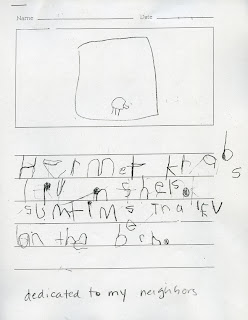
The most important idea to get through to parents and the community is postive encouragement no matter what stage in literacy development a child is in. Happy feedback from parents or others that the students look up to will encourage them to continue to put effort into writing, and this practice will lead our children to making enormous bounds in their abilities.
Monday, January 23, 2012
Digging for Literacy in Our Environment
As parents and teachers, we sometimes fail to realize how packed with opportunities for learning every day trips to seemingly ordinary places can be. One of these trips could be a tour to the local supermarket. Supermarkets are simply throbbing with environmental print and special vocabulary. Some of the words that are supermarket specific that children get to learn while on a visit are the following:
Some of the words that are supermarket specific that children get to learn while on a visit are the following: 
Dairy
Produce
Deli
Health and Beauty
Head (of lettuce)
Aisle
Cart
Frozen
Stock
Organic
Oriental
Gallon
Check out
Customer service
Cashier
Pharmacy
Coupon
Receipt
These and other terms can expand a child's creative thinking and allow them opportunity to develop more complex thoughts and participate in more mature conversations. Including our children in talk while we shop at a market will open their minds to vocabulary that may seem simple and obvious to us, but is wonderfully new to them.
Many of the conversations that were happen on visits to supermarkets are filled with questions and answers. Questions about the locations of items, questions about what one or another person wants for dinner, and commonly asked by children, requests for specific items on the shelves.
These requests come from a child's understanding of environmental print. Children have been previously exposed to labels and logos and through commercials and advertisements, they have developed a desire for, but more importantly an understanding of what those labels and logos are symbolizing. In their requests for items that are special to them, they are showing how they have created meaning in their environment, and through more exposure to and discussion of the activities and items surrounding them, they will have the knowledge to create even more meaning.
Monday, January 16, 2012
Make Some Meaning
Imagine entering a world in which everyone around you spoke a different language. You arrive and your only connection to written and spoken language is the letters that are sent between you and your family whom live in your previous world. Does this make you illiterate in your new home? Wordless picture book author, Shaun Tan tells the story of a traveler who was in this exact situation in his book The Arrival.
 Is the written and spoken language that Tan's main character is literate of the only literacy that he has though? Could the meaning that he is making of the world around him be a form of literacy?
This is a question that we can use in a classroom to build up our value of the different forms of literacy that children could possess. Different classrooms are likely to have children with a variety of first languages, and the literacies that can be universal through the classroom, like picture understanding, can be utilized to create a connectedness in understanding by every student. Being able to appreciate literacy that focuses on meaning making is a broader way to view what literacy is and what different forms of it have the capacity to do by creating mutual understanding.
 Is the written and spoken language that Tan's main character is literate of the only literacy that he has though? Could the meaning that he is making of the world around him be a form of literacy?
This is a question that we can use in a classroom to build up our value of the different forms of literacy that children could possess. Different classrooms are likely to have children with a variety of first languages, and the literacies that can be universal through the classroom, like picture understanding, can be utilized to create a connectedness in understanding by every student. Being able to appreciate literacy that focuses on meaning making is a broader way to view what literacy is and what different forms of it have the capacity to do by creating mutual understanding.
Subscribe to:
Posts (Atom)