Tuesday, April 10, 2012

Popular Cultural as a Tool for Literacy?

We fear implicit stereotypes, hidden messages, leaving a child out because they do not have the equal abundance of popular items as others, but what we do not see is the power that popular culture can have in a classroom context. We do not see the ways that children strongly identify with many of the characters that they are exposed to outside of school. If we can find a way to integrate popular culture into the students' literacy contexts, we will have a path that connects home and school that will motivate students and trigger excitement and imagination.


By allowing students to write about characters that they know, they will have storage of stories and have an even greater capacity to expand upon these stories and themes. When children bring their toys to school, they will be able to use their play to translate to their writing and story telling. It may seem like a stretch to some, but if students are given the opportunity to have their toys with them while they write, the play will encourage imagination in writing and elicit excitement for getting the students' thoughts down onto paper.

So release the fears and start integrating children's outside lives into their school lives with writing inspired by play!

Tuesday, March 27, 2012

Nudging the Talk

Read-alouds are an opportunity to introduce any type of conversation in the classroom. Depending on the book chosen, many different topics can be brought up by children making personal connections to the reading. They can also connect a story to another text or something in the world. Although we will often hear students making these connections on their own, if we nudge the talk, we will find how much conversation can be brought about from a simple topic or story.


Before a story begins, some questions you can ask to get students thinking are the following;


-What do you think this might be about?

-Look at the cover. What do you notice?

-Where do you think this story takes place?

-What might we learn in this book? (if it is nonfiction)

-Who do you think the characters are?

-Can you think of any words we might hear in this book?


During and after a read-aloud, you can ask these questions:

-What are you thinking?

-Talk about what you like about this book so far.

-What do you think will happen?

-Has anything like this ever happened to you or someone you know?

-Does this story remind you of anything?

-Does this character remind you of anyone?

-What are you picturing in your head?

-What are you wondering about?

-What do you notice in the illustrations?

-What do you already know about ______?

-What did you learn so far?


The questions and conversation starters are nowhere limited to these options, but they are some to get you started. You will be able to ask more specific questions or make comments more directly related to the story as conversation goes on, and you will be surprised with all of the connections that students can make!

Monday, March 19, 2012

Poetry as a Medium

Poetry is useful for all of its connections that can be made to the curriculum and to fulfill standards, but it also has the power to open minds to different thought patterns or ways of describing emotional and other experiences. Students will be able to personally connect with the combination of words that they will hear, read, and most importantly, be in conversation about. The conversation will force students in a subtle way to hear and make sense of others' interpretations of the poetry.

The ambiguity of language is a main point that should be adressed, and this idea that the words from a poem and the way that they are combined and arranged can mean very different things to different people, will show my students that differences exist in the understandings that they each have, but no interpretation is the correct one. No one will know what exactly a poem is saying unless they are the poet, therefore bringing up the magic of this type of literature. It carries with it the facility to unify a classroom through shared dialogue that brings mutual understandings that everyone is unique in but valued for their interpretation of poetry, and therefore unique in and valued for their culture, beliefs, appearances, and other realms of differences.

Having said that, the ways that poetry can be incorporated into a classroom are many: one of these ways is through choral reading. A teacher can give an example of how a poem can be read aloud and then spur conversation on how this poem can be read as a class, emphasizing word volume, speed, and pauses that are important to the meaning of the poem. Students can then break into groups and decide in their groups how they will perform a poem of their choice. Once again, confidence in feeling proud of themselves will come from this activity, and it will promote the ability to work as a team and include each students' input in the final product.

Tuesday, March 6, 2012

Between a Rock and a Hard Place

Literacy teachers of young children often find themselves struggling to match their personal philosophpy with the mandates of their state, district, or school. Tests like ISTEP and IREAD have strict skill based requirements that children must be able to meet by the middle of the third grade. Up until this point, teachers are required to give assessments based on skills and conventions that will lead the students to do well on these tests.

Passionate, intentional teachers have the desire to fulfill their students' literacy lives by implementing developmentally appropriate activities into the curriculum. They want actiives that will inspire children to use the resources that they have around them to attmept the usage of challenging words and invent spelling and conventions as they progress on their journey to correct conventional writing.

The harsh pressure to reach certain skills by certain times may actually be hindering the stduents abilities to reach those goals becasue teachers feel pressure to reach these goals by taking a path that they do not believe in. The question is, where to go when there are two (often times more) different angles coming towards you about how to promote literacy. Teachers and administration need to work together to form a combination of discources that fit their school environment and individual students.

Tuesday, February 28, 2012

Does It Make Sense?


As many of us know and something I have previously mentioned in this blog is that it is oh so common to instruct children to "sound it out." What this phrase actually means can be dissected into various strategies like chunking and using the first letter of a word to figure out what the word is. When a word like "this" or "know" come into a reading, without previous memorization a child will not be able to simply "sound it out." This is when a child can turn to the strategy of filling in the blanks with a word that makes sense.


Using context clues can often be the most powerful method for students to use when learning more complicated words. This strategy also encourages reading comprehension, which is the true reason for achieving fluency and accuracy, right?

Encourage children to become investigators and detectives as they discover unknown words! Through practice, this strategy will become natural and students will be able to much more accurately identify unknown words and reach higher levels of comprehension.

Monday, February 20, 2012

Read What You Want!

We hear it over and over again as educators to run with student ideas, tweak your lessons to fit a stduent conversation, do activities that children are interested in and care about. What a wonderful world of education it would be if all of these things were happening all of the time! Although we know that these methods are the best ways to reach children and help them grow as students, we often fail, and one area that it is made easy for us to fail is in literacy. We have been given an "out" to adapting our instruction, and as a result, struggling readers are still struggling, and the education gap is widening.

This "out" that I am referring to is called leveling. Leveling is when texts are matched to readers based on the level that the student has tested into through generic assessments. Some of the leveling programs take many factors into account in these assessments, but many are based strictly on oral reading accuracy. How many of you think that reading level is based only on a child's ability to accurately and fluently read out loud?


That's what I thought.


So why is it that we turn to a system that uses instruction that we know is not the best way to help our children reach proficiency? There are many answers that can be found to that question when the system is disected, but the most simple answer is that in such an overwhelming, complex situation such as leveling, a techer is likely to get overwhelmed, abandon her personal strategies, and simply go by the book. Teachers are stripped of their independence and flexibility to engage when placed underneath a strict system. Either a teacher feels too overwhelmed or he is simply being too lazy to overcome the rigidity of the system.


Either way, there is an overreliance on materials and an underreliance on teacher abilities to take the task, the learner, the materials, and the context into account when giving reading instruction. Once a teacher is able to look past the system and see every outside force as a factor in a student's success, she will be able to choose appropriate, engaging texts for individuals and lead them to the proficiency we have been searching for.

Tuesday, February 7, 2012

Rethinking, Rephrasing, and Reconsidering

As teachers and parents, we all have memories of moments when a child is reading with you, and when they have a question about a word, the only answer that you have is, "sound it out." Sound it out... what are you telling a child to do when you are telling them to do this?

This is a question that a cultural model has left us to not ask. We have grown up being told this and this is the same instruction that we are continuing to give to out students, even though it is not the most effective. Studies have shown that the strategy of sounding it out by using individual letters or chunks of recognizable sounds are not truly the strategies that children naturally use. As teachers fostering the minds of these young children, we want to keep them from making as many mistakes as possible in their journey to reading. Common struggles that readers fall into when instructed to "sound it out" are the following:

-Recognizing the first letter of a word and replacing it with a different word that starts with that same letter
-Taking the context of a story and replacing a word with a word that has similar meaning
-Using the incorrect structure of a word
-Replacing a word with one that looks similar but may have a few different letters
-Asking for help to solve an unknown word
-Using individual letter sounds to come up with a word's whole sound
-Using chunks of words to come up with a word's whole sound

These are struggles that we need to identify in chidren and can word to steer away from by coming up with new, more beneficial strategies to help them. We need to be innnovative and rethink, rephrase, and reconsider the methods we are using.

Monday, January 30, 2012

Dazzled and Delighted


As literacy teachers, we are able to value little victories and see each tiny step towards more conventional writing skills in children as fabulous achievements. However, this may not be the case for how the families and communities of young children experience the writings and stories that these children put their hearts into telling. Educating families and others surrounding these young, progressing minds on what "good" writing is, and the processes that it takes to achieve more advanced writing skills will allow these people to feel enabled to nurture and be dazzled and delighted on what the children can do.


The most important ideas that we can educate the public about are the following;


1. Writing is a system of symbols. If a child can understand this, then they have mastered the first challenge for successful writing. We must look to the meaning of children's writing, not the conventions.

2. Drawing is an effective way of communicating. Parents should look at their children's drawings and see them as plans for writing, much as an outline or venn diagram would be used for an older student. Taking the leap from distinguishing drawing from writing is one that will come in time, but until then, take joy in the pictures and the meanings that they portray.

3. Letters can be written in different ways. Children see letters as flexible tools whose physical appearances can be experimented with. If a child is intending to write a "b" and he writes a "d" this is still a positive step towards imporved writing. We should encourage parents to find the meaning that their child is intending and to not jump to the conclusion that their child is dyslexic or has some other impairment.

4. Words can be spelled in many different ways. If a child spells a word incorrectly, they have still been able to sound it out with their knowledge of phonemic awareness and some memorization, and as long as meaning is being intended, it is okay to have misspellings.


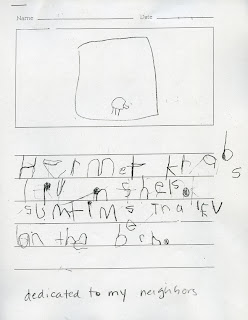
The example below shows a student's story about hermit crabs. Although her some of her words are misspelled, her spacing isn't perfect, and her letters and in the best of form, we can see meaning.


The most important idea to get through to parents and the community is postive encouragement no matter what stage in literacy development a child is in. Happy feedback from parents or others that the students look up to will encourage them to continue to put effort into writing, and this practice will lead our children to making enormous bounds in their abilities.


Monday, January 23, 2012

Digging for Literacy in Our Environment

As parents and teachers, we sometimes fail to realize how packed with opportunities for learning every day trips to seemingly ordinary places can be. One of these trips could be a tour to the local supermarket. Supermarkets are simply throbbing with environmental print and special vocabulary. Some of the words that are supermarket specific that children get to learn while on a visit are the following:


Dairy

Produce

Deli

Health and Beauty

Head (of lettuce)

Aisle

Cart

Frozen

Stock

Organic

Oriental

Gallon

Check out

Customer service

Cashier

Pharmacy

Coupon

Receipt


These and other terms can expand a child's creative thinking and allow them opportunity to develop more complex thoughts and participate in more mature conversations. Including our children in talk while we shop at a market will open their minds to vocabulary that may seem simple and obvious to us, but is wonderfully new to them.


Many of the conversations that were happen on visits to supermarkets are filled with questions and answers. Questions about the locations of items, questions about what one or another person wants for dinner, and commonly asked by children, requests for specific items on the shelves.


These requests come from a child's understanding of environmental print. Children have been previously exposed to labels and logos and through commercials and advertisements, they have developed a desire for, but more importantly an understanding of what those labels and logos are symbolizing. In their requests for items that are special to them, they are showing how they have created meaning in their environment, and through more exposure to and discussion of the activities and items surrounding them, they will have the knowledge to create even more meaning.

Monday, January 16, 2012

Make Some Meaning

Imagine entering a world in which everyone around you spoke a different language. You arrive and your only connection to written and spoken language is the letters that are sent between you and your family whom live in your previous world. Does this make you illiterate in your new home? Wordless picture book author, Shaun Tan tells the story of a traveler who was in this exact situation in his book The Arrival.

Is the written and spoken language that Tan's main character is literate of the only literacy that he has though? Could the meaning that he is making of the world around him be a form of literacy?

This is a question that we can use in a classroom to build up our value of the different forms of literacy that children could possess. Different classrooms are likely to have children with a variety of first languages, and the literacies that can be universal through the classroom, like picture understanding, can be utilized to create a connectedness in understanding by every student. Being able to appreciate literacy that focuses on meaning making is a broader way to view what literacy is and what different forms of it have the capacity to do by creating mutual understanding.

Tuesday, November 8, 2011

Children of Nature or of Technology?

As teachers, parents, and members of the community, we stand divided. Shared opinions from both sides of the divide some from all three groups of people, but the question is, who is right? Who knows best? Who knows if technology should be an integral part of early childhood curriculum to best prepare our children for the iPad, cell phone, computer consumed world that is now our reality?


Across numerous ideals and philosophies of early childhood education, it is believed that the young child learns best through natural materials and sensory experiences. And here is where the view of early childhood philosophy begins to crack. Many people now have the perception that without integrating technology into the classrooms of our pre-schoolers, we are not adequatly preparing them for the world that they live in. This view sees natural experience surrounded currriculum to be an approach that gives our children irrelevant experiences.


But is this true? Does an environment in which children are thriving with their literacy and social skills, not give them the skills that will prepare them to learn the technology later? Perhaps putting technology as a core part of early childhood curriculum will force our children to have a scewed understanding of the natural world. It could make them believe that it is impossible to achieve tasks without technology. Is this the type of dependency that we want our children to struggle with?


Here is a clip from YouTube that will show you how one very young child has already lost her ability to understand that natural world and differentiate from reality and technology. We need to be teaching our children how to problem solve in a vafriety of ways, apart from forcing upon them a technology dependency.


Wednesday, October 26, 2011

Literacy Selection: How "Real" Should Our Choices Be?


Through literature, do we want to be teaching children the way that the world should be, or should we expose them to the sometimes very sad, harsh realities? Linnea Hendrickson, a professor from the University of New Mexico posed this same question in her brief article titled "The World as It Is, or As It Should Be?" Many of us remember growing up with stories of white picket fences and a "perfect" family with two children where the father goes to work and the mother stays home, but is this the perception that we want to give to our children? If a child is in a different home situation, will these literature selections make them feel like something is wrong with them?


I was just recently exposed to a children's picture book titled "Fly Away Home" about a young boy and his father and their caring relationship. Sounds nice right? But the truth is, is that this story, narrated by the son, is about a homeless father and son who live in the airport. The reader experiences the grief that the family has that results from this very difficult life. It can bring up questions and thoughts in the classroom that the children may not be ready for. Or are they ready?


We need to take the time to evaluate the choices that we make for the literature that our children are being exposed to and always have conversation about seemingly perfect stories or ones that portray difficult situations. Conversation is the key about making these stories meaningful.


In the conclusion of Hendrickson's article she says, "I suspect what the best books give us, and what we need, is a little bit of both, even though we do not always agree on'what is' or on 'waht should be.'"

Tuesday, October 18, 2011

What Can Literature Do for You?

As adults, we all have a memory in which we read a short story, a poem, a simple quote, or any other form of literature that produced an intense emotional reaction that stuck with us. For me, I connect most with poetry and its ability to combine beautiful words to create beautiful sentences. This disposition that I have towards literature is a positive one that has been created through carefully selected literature over the years by my parents and teachers. We want to do this same thing for our children as we create positive dispositions for them and encourage their development of a sense of what literature can do for them.


Literature can send powerful messages, and the selections that children read will determine what message a child gets. Further more, the disposition, or attitude, that a child develops towards literature in general will determine if they will grow and retain a love for reading for the rest of his or her life. Enjoyable experiences with literature will help to develop this positive outlook. The ways to do this are the following;

-Bring stories of all children including special needs, talents, and interests, varieties of family structures and socioeconomic statuses, and multiple races and languages
- Having plots that are socially relevant

- Including a wide variety of topics and genres so that
all children can find appeal.

Among these ways, the most important indicator that children are developing the appropriate dispositions are checking for
listening and understanding. Choose what is important for your child to know and empower them to realize what literature can do!

Tuesday, October 11, 2011

Making Music to Learn Language : How Songs, Chants, and Rhymes Develop Phonemic Awareness

With young children, nearly everything that they need to know about the world can be learned through various forms of play. One type of play that can teach is singing songs and learning rhymes! To understand how songs can aid a child in acquiring phonemic awareness, we must first understand what this awareness is...

Phonemic awareness is having a grasp on the structure of language. Although an extension of phonemic awareness, this does not mean understanding written language. Phonemeic awareness revolves completly around the sounds that are made and how they are connected to words and one another. The three main achievements that children will make when grasping phonemic awareness are syllable awareness (the ability to separate and identify syllables), onset-rime awareness (the ability to separate syllables into their beginning and ending sounds), and phoneme awareness (the ability to separate syllables into all the separate sounds that are pronounced). As a helpful reminder, just remember that phonemic awarenss can be taught, learned, and practiced in the dark.


Songs that play with sound are a great way to attain these skills without a child even realizing how much they are learning and accomplishing. For example, the song Apples and Bananas, practices using the same vowel sounds at the beginning of most of the words in stanza. Instead of saying "apples and bananas" one would sing "eeples and baneenees" to understand where the vowels come in a word. The song Down by the Bay practices rimes, and this could be a song that also incorporates creativity as children make up their own verses and practices their understanding of rimes. Both of these songs are examples from the musician and children's songwriter Raffi. Here is a collection of his compositions that would be very fun to explore with your child!


Incorporating music into learning lightens the atmosphere and creates a positive connection for the child by correlating learning with fun and enjoyment. The opportunites are endless for word play in music and even daily activities or conversation that just come up. You will often find that children are eager to develop their own rhymes or phrases with phonemic connections; they just need to follow your lead.


So go ahead and get singing, rhyming, and learning!


Tuesday, October 4, 2011

The Art of Storytelling!

After a visit to the local library and witnessing a story hour put on by a small group of librarians, I realized what a thrilling experience storytelling without books can be for children. Although, the ultimate goal is to develop literacy, working on imagination and creativity and developing a thirst for more stories and information happens during bookless story time.

Stories can be absorbed through narration with props like puppets or an easel with a marker or paint.
Stories can be experienced through songs, rhymes, or chants.
Stories can be shared with body language, eye contact, and voice inflection.

All of these things and more were occuring during the library's story time and the leaders were sure that the children were staying engaged through question asking and movement instruction. The idea that these stories came from books, had the children rushing to the stage at the end of the hour to snatch the books on display so they could take them home to read.

Any of these variations of storytelling can be done at home also! Pick a prop from anywhere in your home and transform it into something magical from a story book. Your child will see a popcorn bowl as a bubbling cauldon or a simple couch throw as the cape of a mysterious character when you make storytelling into something more than simply reading a book. This excitement that is created is the key to cultivating lifelong readers.

Tuesday, September 27, 2011

Intentions to Connect

We all remember hearing the initial coos or the first repetitive sounds of babbling that come from our babies’ mouths. Do you think they were trying to tell you something? Anyone’s answer to this question is yes, and the same thing translates over to children acquiring written language just as they did with oral language.
When children draw pictures or write in scribbles, they have intent to connect and communicate, just as they did with their pre-language sounds. There are five levels that you may find your child in or between as he develops his ability to write meaningfully. These steps are the following;

1. Your child is in the scribbling/drawing stage when he makes uncontrolled drawings that are not recognizable.
2. The pictorial stage is when your child’s drawings become slightly recognizable and she imitates other writing from anywhere that she sees it.
3. At the precommunicative stage, children can often write their own name and a few other known words.
4. Next is the semiphonetic stage in which children can from most letters correctly, understands that writing goes from left to right and top to bottom, and can spell some harder words that they see frequently.
5. The phonetic stage is when your child begins to identify punctuation (including spaces between words) and represents most consonant and some vowel sounds with his spelling interpretations.
6. The final phase in written language attainment is transitional. This is when children mostly use correct capitalization, spacing, and logical phonetic spelling.


A child may spend more time than the next at one level, or may skip a level entirely, but learning to write and spell correctly is a process. We must always keep in mind that when children are working away on their scribbles or writing down incomprehensible words, that they are still intending to communicate. Developing authentic or meaningful ways for children to communicate through writing will help them glide through these steps and become proficient writers!

Tuesday, September 20, 2011

Learning from the Environment

Hello parents!


One of the ways that we can be the best parents and teachers is to look at what our children really already know. You may be surprised with what you find. An example of this can be found when taking a look at something called environmental print. Environmental print is any sort of symbol, logo, sign, or written words that are find in your child's environment. Anything from street signs to shirt tags are enhancing your child literacy capabilities and recognition every day.


In our classroom, we are going to be building on this seemingly hidden capability by using your child's symbol recognition to connect these symbols with letters. This is importnant for our classroom because one of the first steps in developing literacy is understanding that something on a piece of paper, or sign, cereal box, etc. has a meaning in verbal language. This will then translate that letters and symbols that make sounds.


To furthur encourage this in your home, you can pull out a type of food box that you often prepare for your child and ask them what it is. I bet you they will know! Even if it is just because they recognize the symbol, but not the words. Sharing with me and with each other what your children know and recognize will open doors to furthur encouraging the recognition capabilities making them feel independent and motivated to practice more symbol recognition, and then recognition of letters and words!

Tuesday, September 13, 2011

Let's Get to Know Each Other


After this first week of interactions with your children and learning what I can from my interactions with them only, I am happy to say how thrilled I am with the diversity and curiosity for learning that each brings. I want you and I to be a team that is constantly collaborating and communicating to help each other help your child reach his or her full potential.


This being said, the more that we share with each other, the more beneficial the moments that your child spends with me will be. Encourage your child to fill me in on what they did at home the previous evening or weekend, and I have high hopes that you will be eager to talk about your child's day at school with them. I want to know what interests your child has and what makes him/her go "wow!" This way, we can together create methods of education that will be most effective and enjoyable in your child's academic journey.


Bringing eveyone's interests and characteristics into the classroom will spark curiosities among the other students and create bonds within them while they share and have conversation about what they like and dislike, know and don't yet know, and have or have not experienced. I can't wait to have more conversations with you about your fascinating children, and am looking forward to exciting and engaging lesson plans that will be developed based on the interests your child gifts the class with.

Thursday, September 1, 2011

Importance of Social Play in Literacy Development

As we begin the school year, I would like to emphasize the role of play in our preschool classroom. Play is a facilitator of every type of learning at this young age as it stimulates the mind and the body. In this particular instance, I would like to share how play will have a huge part in your children's literacy development.


  • Play encourages social interaction. In being social, children are able to feed off of each other and share knowledge of written language. By acting out a particular event in which spoken words are used to communicate written words, (ie. playing restaurant and having the server writing down an order for food) children are able to furthur understand that those written markings on paper actually have meaning.

  • Play allows a child to "behave beyond his average age, above his daily behavior; in play it is as though he were a head taller than himself." This quote was made by behavior theorist L. S. Vygotsky. Through my experience, I have found this to be very true as, through play, children take on roles that at their age would not be realisitc. But in acting out these characters, they use language that is also beyond their daily behavior. Through play, their literacy and language horizons are broadened.

I hope that this snippet of information has given you an eager outlook on how we will work together to enhance your children's literacy development and passion for reading!